In my last post, I wrote about how a single word in a nineteenth-century record changed the direction of the Rigali story. But identifying a record is only part of the work. The other part is gaining access to it.
That is where genealogy becomes less about search terms and more about people.
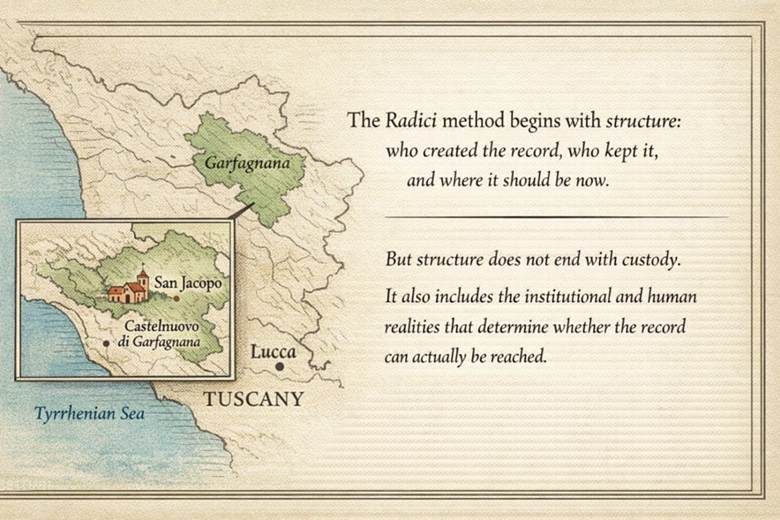
Once the trail led into the parishes of Garfagnana, a mountainous area in northern Lucca province, the usual habits of modern research stopped being enough. There was no searchable database, no clear request portal, and no guarantee that a carefully written email would reach the right person at the right moment. The records existed. The challenge was access.
What this search taught me is that parish research has its own etiquette. That etiquette is not incidental to the work. It is part of the work.
Sometimes the messenger matters
Before we ever saw a page from the San Jacopo registers, I spent months trying to make contact. I sent emails. I made phone calls. I tried text messages. Nothing worked.
The problem was not the request itself. It was the messenger.
For a small parish, a message from abroad can be easy to set aside, even when it is careful and respectful. It may arrive in the wrong language, with the wrong tone, or simply as one more demand on someone whose life is already full. What changed the situation was not a better argument. It was a different approach. Sylvia called on our behalf. She is local, speaks the language naturally, and understands the pace and expectations of the place. He answered her immediately.
I was reminded that in genealogy, the question is not only how to ask. Sometimes it is also who should ask.
A parish is not a government office
This should be obvious, but it is easy to forget when moving back and forth between civil and ecclesiastical records.
Civil offices operate within formal systems. There are procedures, legal obligations, published hours, and often fixed fees. Parish records are different. They belong to the Church, and access to them often depends on the judgment, time, and goodwill of the person responsible for them.
A priest is not a clerk, and in most cases not a full-time archivist. When we ask for help with parish books, we are asking someone to step away from pastoral work, parish administration, and daily obligations in order to assist with historical research. That does not mean we should not ask. It means we should ask with the right expectations.
Donations are part of the etiquette
I think it helps to be clear about what a donation is, and what it is not.
It is not a bribe. It is not a municipal fee. And it should not be thought of as a way to pay for results.
A parish archive exists because a church remained standing, because registers were preserved rather than discarded, and because someone, over a long period of time, took seriously the responsibility of keeping them safe. When we ask to consult those books, we are benefiting from that continuity. A donation is one way of recognizing the institution, its history, and the stewardship that made the records available to us at all.
There is also the simple matter of time. If a priest searches for a name, answers repeated messages, checks a register, or arranges access to images, he is giving time that has been taken from other responsibilities. A donation acknowledges that effort whether or not the search produces the result we hoped for.
That point matters to me. I once gave 20 euros for a search that turned up nothing. I did not regret it. The donation was not for success. It was for the time spent looking, and for the willingness to make the effort at all.
As for amount, I think the right approach is to be modest, serious, and proportionate. For a simple look-up or brief assistance, 20 to 30 euros seems reasonable, as of this writing. If someone has spent more time, handled multiple requests, or photographed and sent records, then 50 euros or more may be more appropriate. There is no universal formula, and local expectations vary. But I would rather err on the side of generosity than act as though parish help costs nothing simply because no official fee schedule exists.
Access often comes in stages
In our case, the first thing we received was a spreadsheet. Useful, certainly, but still one step removed from the records themselves.
It took patience, the right intermediary, and a respectful return to the request before we finally obtained images of the original pages. That sequence mattered. In this kind of work, access is not always granted all at once. Sometimes the first answer is limited. Sometimes that reflects caution. Sometimes it is simply a way of determining whether the researcher is serious, respectful, and worth engaging with further.
A partial answer is not always a refusal. Sometimes it is the first opening.
What this reinforced for me
What this experience reinforced for me is that the research begins with structure: who created the record, who kept it, and where it should be now. But structure does not end with custody. It also includes the institutional and human realities that determine whether the record can actually be reached.
A parish archive is not only a repository. It is a living institution, shaped by responsibility, time, hierarchy, and local habit. Research that ignores those structures will often stall, even when the records survive.
That is why this, too, was structural research.
About the author
Janet Tognetti Schiller teaches Italian genealogy at the Washington, D.C. FamilySearch Center. She holds a doctorate in education from Harvard University and has completed several advanced genealogy courses. For more information, or to join the Italian Genealogy Special Interest Group, visit the FamilySearch Center’s website at WDCFSC.com.
Acknowledgments
We owe a debt of gratitude to Sylvia Hetzel (The Italian Genealogist) for research performed on site at the Chiesa di San Giacomo in Fabbriche di Vallico, Gallicano, Lucca.
Radici
© 2026 Janet Schiller
Understanding the structures behind Italian genealogy.
 Radici.blog
Comments are moderated. Substantive contributions are welcome.Leave a Reply