What it’s good for—and what it isn’t
Genealogists often have a love-hate relationship with Facebook.
On a good day, it can connect us with knowledgeable people, local history groups, parish pages, and researchers who have already wrestled with the same locality, archive, or handwriting problem. On a bad day, it can be a graveyard of vague questions, unrealistic expectations, and answers offered with great confidence but very little substance.
So which is it?
In my experience, Facebook can be genuinely useful for genealogy—but only if we are clear about what it is, and what it is not.
Social media is a tool, not a source
The most important distinction is this: social media is a tool, not a source.
A Facebook post may point you toward a clue, a contact, or a new line of inquiry. It may help you identify a parish, locate a local group, or learn how residents of a town refer to their church, cemetery, or neighborhood. But it is usually not where proof lives. Proof still lives in the records: civil registration, parish registers, stati delle anime, notarial acts, cadastral records, and other original sources.
That does not make Facebook unimportant. It just means we need to use it for the right things.
When genealogy questions on Facebook go wrong
One of the clearest ways to see the limits of Facebook is to look at the kinds of genealogy questions people ask there.
Recently I saw one that went something like this: I’m going on a research trip to Italy. What or who do I need to know to access records?
At first glance, that sounds like a reasonable question. But once you start to think about it, it is almost impossible to answer well. Civil records or parish records? What years? Which town? Which archive? What has already been checked online? Does the person speak Italian? Is the goal to consult records in a comune office, a diocesan archive, a parish sacristy, or an Archivio di Stato?
Without that context, any answer is likely to be broad and generic. The question is simply too vague.
Another example was even more revealing. Someone wrote that they had surnames like Rossi, Verdi, Martini, and Bianchi in their family tree and had spent years reaching out on Facebook to people with those surnames, in English, asking whether they were related or knew the family.
This is not a research strategy. It is wishful thinking.
Common surnames do not establish kinship. And messaging strangers in another country in English with a vague “Are we related?” is not likely to produce much beyond silence. Many Italians may understand a little English, but understanding a little is not the same thing as being able—or willing—to answer a genealogical question in English. Even when translation tools are readily available, it is unwise to ask people questions in a language they may not feel comfortable answering.
It is also worth considering your audience. If your intended readers speak Italian, write in Italian. There are now many tools that can translate your words into another language quickly and easily, so it makes sense to use them. Even if your Italian is imperfect, making that effort shows respect and greatly improves your chances of being understood.
Both examples point to the same problem: the hope that Facebook will somehow compensate for a poorly defined research question. Usually it will not.
Clear questions get better answers
If you want useful help on social media, you need to ask a question that can actually be answered.
That means being specific. It means identifying the place, the time period, the record type, and what you have already checked. It means showing that you have done some preliminary work. A good Facebook question might look more like this:
I am researching early nineteenth-century records in San Rufo, Salerno. I have already checked Antenati and FamilySearch. Does anyone know whether parish records survive locally, or whether there is another archive that holds them?
Now that is a question people can work with.
It tells the reader where you are working, what sort of records you seek, what time period is involved, and what avenues you have already tried. It also makes clear that you are not asking the group to do all the thinking for you.
When Facebook is genuinely useful
And yet, for all my frustration with bad Facebook questions, I have also found the platform genuinely useful.
A good example is a Campania town I have been researching recently. I joined two local Facebook groups—Quelli di San Rufo and Sei di San Rufo se…—that provided meaningful information. The town also has two Facebook pages for its parish church, although one of them probably should have been taken down in 2016.
Messy? Yes. Useful? Also yes.
These groups and pages were valuable not because Facebook itself is magical, but because they brought me closer to a specific place and the people connected to it. They offered local context. They showed how the town presents itself online. They hinted at which institutions are active, dormant, duplicated, or poorly maintained. Even an outdated parish page can contain useful breadcrumbs: names, photos, feast day notices, contact details, references to clergy, or links to something newer.
That is where Facebook shines in genealogy: not as a source of evidence, but as a map of living communities.
A locality-based Facebook group can help you see what matters in a town. It can help you understand how residents talk about their parish, patron saint, neighborhood, or cemetery. It may help you identify who actually knows the local terrain. It can also help you determine whether your question makes sense before you send it out into the world.
In that sense, Facebook is often good for orientation. It helps us move from the general to the specific.
Platforms are not the same as data sources
That matters because genealogists sometimes blur an important distinction between platforms and data sources. Not every website serves the same function. Facebook is a platform for communication and community. FamilySearch and Antenati are repositories of records. Ancestry is a bit of both, but much of what circulates there comes from user trees rather than original documentation.
If we do not keep those categories straight, we begin to treat discussion as if it were evidence. That is when trouble starts.
What Facebook is good for
It can be excellent for finding locality-based groups, identifying parish pages, learning from the experience of others, asking focused practical questions, getting help with a small translation problem, and discovering resources you may not have known existed. It can also help you locate local historians, volunteers, or people with direct knowledge of a place.
What Facebook is not good for
It is not good for proving relationships. It is not good for rescuing a badly framed question. It is not good for turning shared surnames into meaningful evidence. And it is not a substitute for records.
Perhaps most of all, Facebook is not very good at encouraging slow thinking. Genealogy rewards patience, context, and careful analysis. Social media rewards speed, brevity, and confident replies. Those are not always compatible habits.
Use Facebook, but use it with intention
Still, I would not discourage genealogists from using Facebook. I use it myself. I have benefited from it. But I try to remember what it can and cannot do.
Use Facebook to find communities. Use it to locate local knowledge. Use it to ask focused questions. Use it to gather leads.
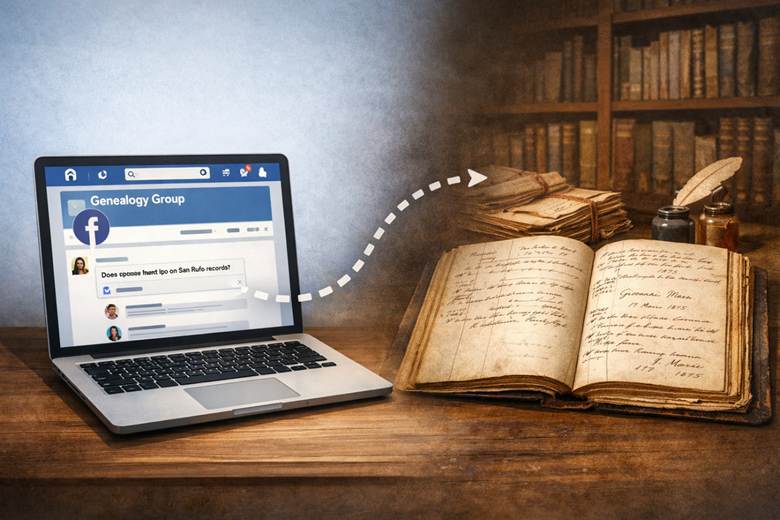
Then leave Facebook and go verify those leads in the records.
In genealogy, social media can open doors. But sooner or later, you still have to walk into the archive.
 Radici.blog
Comments are moderated. Substantive contributions are welcome.Leave a Reply