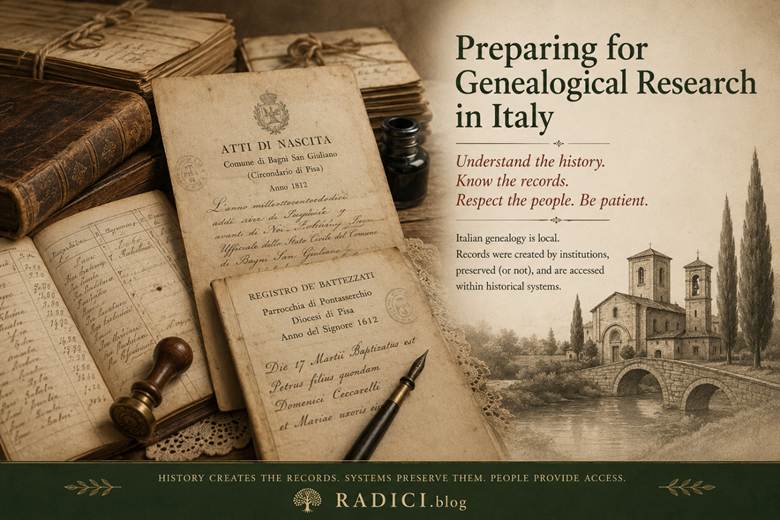
Many people begin Italian genealogical research believing that once they identify an ancestral town, the rest is simply a matter of searching for records online. In reality, identifying a place of origin is only the beginning.
Italian genealogy is not just about names and dates. It is about understanding history, geography, religion, government, language, and archival systems. To research effectively in Italy, it is important to understand who created genealogical records, why they were created, how they were preserved, and where they may be found today.
Most importantly, it is essential to understand that Italy was not historically a single unified country. Before unification in the nineteenth century, the Italian peninsula consisted of multiple states, kingdoms, duchies, republics, and territories under foreign control. As a result, record-keeping practices varied enormously from one area to another.
Two neighboring towns may have completely different archival realities.
Some areas maintained strong civil registration systems during the Napoleonic period and continued them afterward. Others abandoned them for decades. Some dioceses centralized parish records. Others left them in local parishes. Some records were carefully preserved and transferred to state archives. Others were lost to war, flood, neglect, or administrative failure.
Understanding how a locality functioned historically is often just as important as identifying the ancestors who lived there.
Know the Major Time Periods
Italian records make much more sense when placed in their historical time period. The exact dates vary by region, but researchers can use four broad periods as a starting framework.
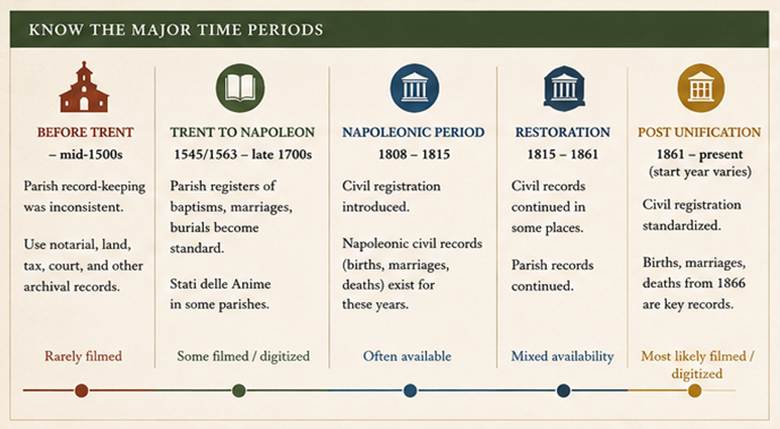
Before the Council of Trent
Before the mid-sixteenth century, systematic parish record-keeping was inconsistent. Some records exist, especially in important churches or institutions, but many ordinary parish registers do not survive from this period. Research before this era often depends on notarial records, land records, tax records, court records, noble family archives, or local archival collections.
This period is rarely the first place a beginner should start.
From Trent to Napoleon
After the Council of Trent (1545–1563), Catholic parishes increasingly kept registers of baptisms, marriages, and burials. These records are often the backbone of pre-civil-registration Italian genealogy.
However, access varies widely. Many parish records remain in local parishes. Some have been transferred to diocesan archives. Some have been filmed or digitized, but most have not.
For this period, the most likely useful records are parish registers, especially baptisms, marriages, deaths or burials, and sometimes stati delle anime.
From Napoleon to Unification
The Napoleonic period introduced civil registration in many parts of Italy. After Napoleon’s fall, the situation became complicated. Some states continued civil registration in some form; others abandoned it or changed the system.
This is one of the most regionally variable periods in Italian genealogy.
In some places, such as parts of Tuscany or southern Italy, excellent civil records may exist. In others, the researcher may need to rely heavily on parish records until post-unification civil registration begins.
For this period, look for Napoleonic civil records, Restoration-era civil records where they exist, parish records, marriage supplements, and sometimes military or population records.
Post-Unification
After Italian unification, civil registration became more standardized. For most of Italy, civil birth, marriage, and death records from 1866 forward are the main foundation of research.
These records were generally created by the Comune, often in duplicate. One copy remained locally, while another was sent through the judicial system and later, in many cases, to the Archivio di Stato.
This is the period most likely to have been filmed or digitized, especially when records were held by state archives or tribunals.
What Has Been Filmed?
Most large-scale filming and digitization of Italian genealogical records has been done by FamilySearch, often in cooperation with Italian archives or government institutions.
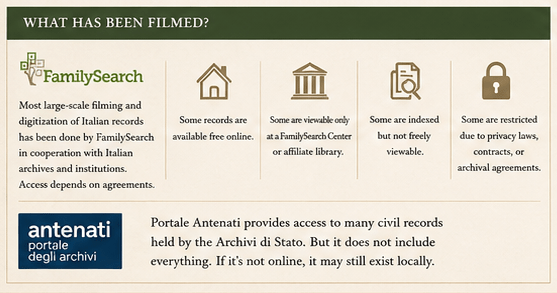
But access is not entirely controlled by FamilySearch. FamilySearch can only provide access according to the agreements under which the records were filmed or digitized. Some records may be available from home. Others may be viewable only at a FamilySearch Center or affiliate library. Some may be indexed but not freely viewable online. Others may have been filmed but are restricted because of privacy rules, contractual limits, or archival agreements.
FamilySearch does what it can within those agreements.
Portale Antenati, the Italian state archive portal, provides access to many civil records held by the Archivi di Stato. But it does not include everything. If a record set is not on Antenati, that does not necessarily mean it does not exist. It may still be held by a Comune, a tribunal, a parish, a diocesan archive, or another repository.
The practical lesson is this: online availability reflects the history of record creation, survival, transfer, filming, digitization, and access agreements. It is not a complete inventory of everything that exists.
Create a Locality Guide Before You Begin
One of the most useful things a researcher can do before searching for records is to create a locality guide.
Many genealogists immediately begin searching databases without first understanding the locality itself. But Italian records were created by institutions — civil governments, churches, tribunals, archives — and those institutions differed from place to place.
A locality guide helps organize the historical and administrative context surrounding a town and can prevent countless hours of wasted research.
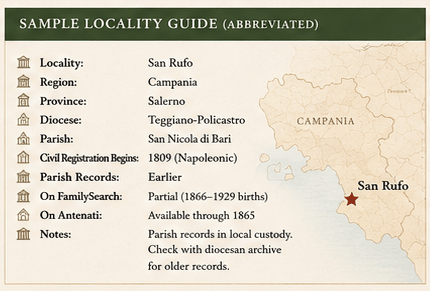
A good locality guide should include:
Geographic Information
- Comune
- Province
- Region
- Nearby frazioni or hamlets
- Historical political jurisdictions
Ecclesiastical Information
- Parish or parishes serving the locality
- Diocese and archdiocese
- Whether records remain in local parishes or were centralized in a diocesan archive
Civil Administrative Information
- Which state governed the locality before Italian unification
- When civil registration began
- Whether Napoleonic records exist
- Whether Restoration-era civil records survived
Judicial and Archival Information
- Tribunal jurisdiction
- Archivio di Stato holding duplicate records
- Availability on FamilySearch or Portale Antenati
Research Notes
- Known gaps in records
- Local naming conventions
- Language patterns
- Paleographic challenges
- Migration patterns
In Italian genealogy, understanding the locality is often more important than understanding the surname.
Because locality guides require the integration of geography, history, civil administration, ecclesiastical structure, and archival practice, I created the Radici GPT to help researchers organize and interpret this information more effectively. Radici is available free of charge to anyone who uses ChatGPT. It can assist with identifying dioceses, explaining historical jurisdictions, locating archives, drafting correspondence in Italian, interpreting records, and building locality guides tailored to specific Italian towns.
Who Created the Records?
Genealogical records in Italy generally fall into two broad categories: religious records and civil records.
Religious Records
For centuries, the Catholic Church was the primary institution responsible for recording baptisms, marriages, and burials.
Many parish registers were created following the Council of Trent, which standardized sacramental record-keeping throughout much of the Catholic world. These records were not created for genealogy. They existed because the Church needed to administer the sacraments and document membership within the parish community.
Depending on the locality and time period, parish records may include:
- Baptisms
- Marriages
- Deaths or burials
- Confirmations
- Stati delle Anime (parish census records)
Some parishes maintained remarkably detailed records for centuries. Others produced sparse or inconsistent records. Some registers survive intact; others disappeared through war, flooding, humidity, neglect, or simple administrative breakdown over time. These records are especially important for periods in which there was no civil registration, but they are also valuable for other time periods.
Civil Records
Civil registration developed unevenly across Italy.
In many areas, civil registration first appeared during the Napoleonic era in the early nineteenth century. After the fall of Napoleon, some Italian states continued civil registration systems, while others abandoned or weakened them during the Restoration period.
Following Italian unification, civil registration became more standardized, especially after 1866.
Civil records may include:
- Birth records
- Marriage records
- Death records
- Marriage supplements
- Population registers
- Military records
Understanding the historical timeline of a locality is critical. A researcher working in Tuscany may encounter very different civil registration patterns than someone researching Sicily, Veneto, or the former Papal States.
The Chain of Custody
One of the most misunderstood aspects of Italian genealogy is the chain of custody of records.
Records do not exist in a vacuum. They were created by institutions and often moved between institutions over time.
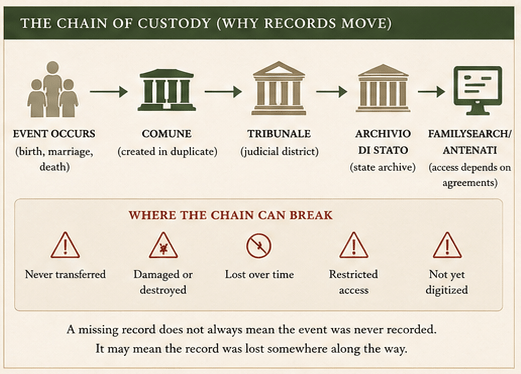
For example, nineteenth-century civil records were commonly created in duplicate:
- One copy remained at the Comune.
- Another copy was sent to the local tribunal.
- Later, many tribunal copies were transferred to the Archivio di Stato.
Today, some of those records appear online through FamilySearch or Portale Antenati. Others remain only in municipal archives or state archives. Still others may have been lost along the way.
Sometimes the system worked beautifully. Sometimes it did not.
A missing record does not always mean the event was never recorded. Sometimes it means the record was lost somewhere along a very long historical journey.
The Challenges of Parish Research
Parish research can be especially rewarding — and especially challenging.
In some dioceses, older parish records have been centralized in diocesan archives. In others, records remain in individual parishes under the control of local clergy.
Many researchers become frustrated when parish inquiries go unanswered. But it is important to understand the reality facing many Italian parishes.
The parish priest receiving your email may:
- have limited English skills,
- receive many requests from abroad,
- have no archival training,
- have no dedicated archivist,
- and already be responsible for Masses, funerals, catechism classes, administration, and the daily life of the parish.
For many clergy, these are not “genealogical records.” They are sacramental records connected to the religious life of the community.
Your genealogy request may be the most important email you send that week. For the priest receiving it, it may arrive between a funeral and a leaking church roof.
Patience and respect matter.
Language Matters
You do not need to speak fluent Italian to conduct Italian genealogical research. But making an effort to communicate clearly and respectfully in Italian can make an enormous difference.
Do not assume that an Italian archivist, municipal employee, or parish priest will feel comfortable reading or responding in English, even if they understand some English.
Today, AI tools can help researchers draft polite and reasonably accurate messages in Italian. Use them.
Keep requests concise and specific:
- provide names,
- dates,
- locations,
- record types,
- and any known family relationships.
Make it easy for the recipient to say “yes.”
A vague request requiring hours of research is much less likely to receive a response than a focused request with precise information.
Handwriting, Latin, and AI
Italian genealogical records can be difficult to read. Researchers may encounter:
- challenging handwriting,
- archaic terminology,
- Latin,
- abbreviations,
- and regional vocabulary.
Fortunately, both civil and religious records often follow highly formulaic patterns. Learning the key terms associated with each type of document makes every new record easier to understand.
AI tools can now assist with:
- transcription,
- translation,
- handwriting interpretation,
- and recognizing recurring formulas.
They are powerful tools — but they are not magic. Researchers should still learn how records are structured and verify important names, dates, and relationships carefully.
Patience, Respect, and Money
Questions about payment and donations often make researchers uncomfortable.
In many cases, municipal archives or state archives publish fees clearly in advance. Their staff are salaried employees working within formal administrative systems.
Parish research is often different.
When asking a parish priest or local church official to search records, it is respectful to offer a donation for the time involved, even when no fee has been requested. A modest offer — often at least 20 euros, and more for extensive research — acknowledges that the person assisting you is taking time away from many other responsibilities.
Importantly, you are not paying for results, which nobody can guarantee.
You are offering compensation for the time spent attempting to help you.
Even a negative search requires time and effort.
Some clergy will accept a donation. Others will politely refuse. Either response should be respected graciously.
Italian genealogy can be challenging. But it is also deeply rewarding. Few places in the world preserve continuity of family, parish, community, and local identity as strongly as Italy. Understanding how records were created — and how they survived — is often the first real step toward understanding the lives of the people who created them.

 Radici.blog
Comments are moderated. Substantive contributions are welcome.Leave a Reply