For many researchers, Italian genealogy proceeds through several stages. First, you identify an ancestor’s Italian name and place of origin. Then you use the civil records to reconstruct the family, often for several generations. Eventually, however, the civil records run out. To continue further back, you must make the transition to parish records.
In a small village, that transition may be simple. There may have been only one parish, or perhaps two or three possibilities. In a city such as Pisa, however, there were many parishes. Searching all of them blindly is neither practical nor necessary.
Very often, the civil records you have already found contain clues that can help you determine where to look next.
Why indexing matters—especially in a city
Indexes are enormously valuable in Italian genealogical research, and particularly in urban research. If a small comune recorded only a few hundred births in a year, it may be feasible to browse its registers page by page. In a city with a much larger volume of records, the same strategy quickly becomes impractical.
The good news is that record access is changing rapidly. FamilySearch is increasingly using artificial intelligence and handwriting-recognition technology to make historical records searchable. AI now performs the initial indexing of many records, with volunteers reviewing its work, allowing FamilySearch to make records searchable much faster than was possible when every entry had to be manually indexed. FamilySearch is also expanding its AI-powered Full-Text Search to collections that have not received traditional indexes. FamilySearch describes the changes here.
For urban researchers, this is potentially transformative. A collection that once required paging through thousands of images may suddenly become searchable.
But indexing is not a one-stop solution.
An index can help you find a record. It cannot be assumed to contain everything in that record, and neither a human indexer nor an AI transcription should be assumed to have interpreted every word correctly.
The first rule is therefore simple:
Always read the original record. Don’t stop with the index.
Sometimes the record tells you the parish
Researchers working with Tuscan records from the Restoration period will frequently encounter two geographic terms on the preprinted forms: Comunità and Popolo.
They describe two different kinds of geography.
The Comunità was the civil administrative jurisdiction—roughly comparable to the later comune. The Popolo, in this context, identified an ecclesiastical community associated with a parish.
That distinction reflects the unusual system of civil registration established in the restored Grand Duchy of Tuscany. After the Napoleonic period, responsibility for recording vital events returned to parish priests. The Ufficio dello Stato Civile established in 1817 then coordinated the collection of this information throughout the Grand Duchy. Parish priests completed forms that were transmitted through the civil administration and ultimately to the central office in Florence. The Archivio di Stato di Firenze provides an excellent explanation of how the system worked.
For genealogists, this can be extremely helpful. If a record identifies both the Comunità di Pisa and the Popolo di San Frediano, for example, you may already have the information you need. Your next task is to determine where the historical registers of San Frediano are preserved and how you can consult them.
But records are not always so obliging.
What if the record tells you only “Pisa”?
Some records—particularly more free-form records—may identify only the Comunità. Knowing that an event occurred in the Comunità di Pisa establishes the civil jurisdiction, but that does not tell you which of the city’s many parishes served the family.
This is where details that FamilySearch may not have extracted become important.
An index is a finding aid. It may give you a person’s name, date and a standardized place. The original record may contain considerably more: a Popolo, a street, a house number, an occupation, a neighborhood, or some other geographic clue.
For urban research, an address can be particularly valuable.
Start with the easy solution
Old street name does not necessarily mean difficult research.
In one Pisa death record I was researching, the deceased was recorded as living on Lungarno Regio. That street name no longer appears on a modern map.
A Google search quickly solved the problem: Lungarno Regio is now Lungarno Antonio Pacinotti.
That immediately told me where in Pisa I was looking.
Google should therefore be one of the first tools you try. Searching an old street name in quotation marks along with the name of the city can sometimes identify its modern equivalent in seconds.
But Google cannot always solve the problem.
When you need a historical map
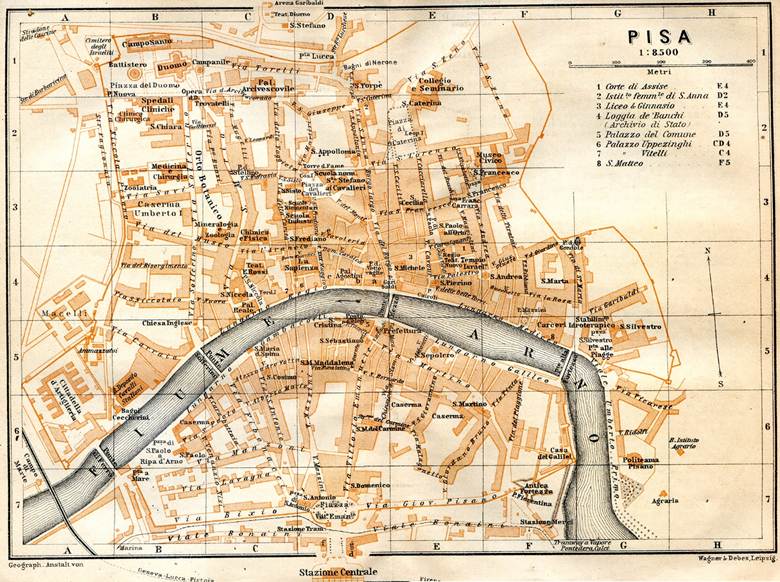
I have an 1898 map of Pisa that has repeatedly proved useful for this kind of research. It preserves street names and urban geography much closer to the period in which my ancestors lived.
For example, another record gave an address on Via S. Anna. The street survives in the modern city under a different name, but the historical map makes its location clear. It places the address in the area surrounding Santa Caterina.
That doesn’t prove parish membership. It does, however, give me a logical parish to investigate.
Historical maps are especially valuable when a street has been renamed, disappeared, or changed enough that modern geography obscures the relationship between an address and the churches surrounding it.
Sometimes the street name itself is a clue
Don’t treat a street name merely as an address. Read it.
One of my records gives an address on Via di Marina. The street now has a different name, but the historical name itself tells us something about its geography: it was a road leading in the direction of the coast.
That clue suggests looking toward San Piero a Grado, a community between Pisa and the sea. Other evidence concerning this particular family also points toward San Piero a Grado.
Again, this isn’t proof. It is a hypothesis.
But urban genealogy often advances by developing good hypotheses and then testing them against the records.
The same principle applies to names such as Via di Gello, roads named for city gates, churches, neighboring settlements, and other geographic features. A historical street name may tell you where the road was going as well as where it was.
The nearest church is a hypothesis, not proof
Lungarno Regio provided an especially useful demonstration of the limits—and the value—of this approach.
After identifying modern Lungarno Pacinotti, I looked at my 1898 map. San Nicola was nearby.

It seemed reasonable to ask whether someone living on Lungarno Regio would have belonged to the parish of San Nicola.
So I asked Dott.ssa Elisa Carrara of the Archivio Storico Diocesano di Pisa.
Her answer was more interesting than a simple yes or no: Lungarno Regio was divided between the parishes of San Nicola and San Frediano.
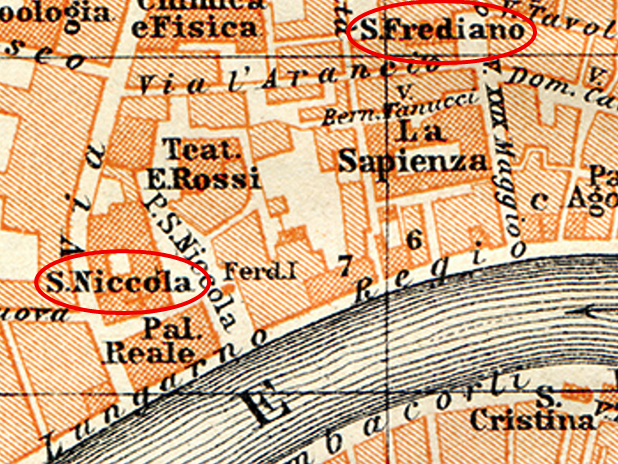
Unfortunately, the death record did not include a house number. I therefore cannot determine from the address alone which of the two parishes was the correct one.
But that does not make the exercise a failure.
I began with an ancestor somewhere in the city of Pisa and numerous possible parishes. I ended with two: San Nicola and San Frediano.
Two churches are much better than going in blind.
What if the index itself is wrong?
There is another reason to read the image and learn the geography of the place you are researching: indexes sometimes get places wrong.
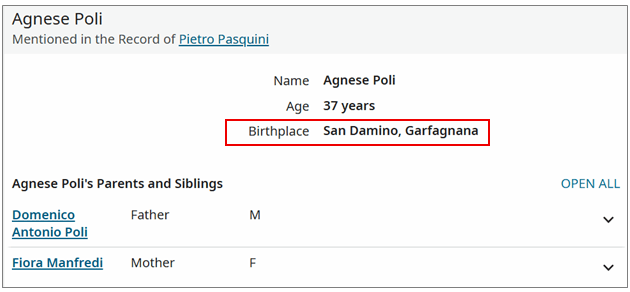
I recently encountered a FamilySearch rendering that appeared as San Damino, Garfagnana. Once I examined the original information and considered the geography of the Garfagnana, San Donnino, in the province of Lucca, made much more sense.
An unfamiliar place name can be intimidating if you encounter it cold. It is much less so if you have already prepared a locality guide and are familiar with the names of nearby towns, frazioni, parishes and churches.
Instead of wondering, “Where is San Damino?” you can ask the much more productive question, “Could this actually be San Donnino?”

FamilySearch is enormously useful, but an indexed place name is an interpretation of what appears in the record. It is not a substitute for the record itself.
Prepare before you search
This is one reason I am a strong believer in preparing a locality guide before undertaking extensive research in an unfamiliar area.
At minimum, learn something about:
- the comune or historical comunità;
- its frazioni and smaller localities;
- neighboring communities;
- the parishes, pievi and other important churches;
- historical and modern place-name variants;
- important streets and geographic features; and
- the historical maps available for the area.
You do not need to memorize all of this. The purpose is to create a reference you can consult when something unexpected appears in a record.
The more familiar you are with the locality, the more likely you are to recognize a clue—and the less likely you are to be led astray by an indexing error.
Follow the clues
Finding an ancestor’s parish in an Italian city is not always a single lookup.
Indexes—whether created by volunteers or increasingly with the assistance of AI—can make an otherwise overwhelming collection searchable. But finding the record is only the beginning.
Sometimes the Popolo identifies the parish for you. Sometimes an address places the family in a particular neighborhood. Google may connect an obsolete street name with its modern equivalent. A historical map may preserve geography that has disappeared from the modern city. The name of the street itself may point toward a particular locality. And sometimes an archivist, a stato delle anime, or another source is needed to distinguish between two neighboring parishes.
You do not always have to identify one parish with certainty before beginning your search. Reducing twenty possibilities to two or three is progress.
The bridge from civil records to parish records is often already there in the civil record. An index can help you find that record. But you still have to read it—and know enough about the locality to recognize the clues when you see them.
Historical maps are especially valuable when a street has been renamed or disappeared, or when modern geography obscures its relationship to nearby churches. Finding useful historical maps is a subject in itself—and one I will return to in a future post.


Comments are moderated. Substantive contributions are welcome.Leave a Reply