For genealogists, Sicily can be extraordinarily rewarding. Civil registration extends well into the early nineteenth century. Parish records may take a family back centuries further. And Sicily has additional sources, including the Riveli di beni e anime, that can reveal entire households long before modern civil registration.
But there is a catch.
To find those records, it is not enough to know that your ancestor came from Sicily—or even to know the name of the town.
You need to understand the systems that created and preserved the records.
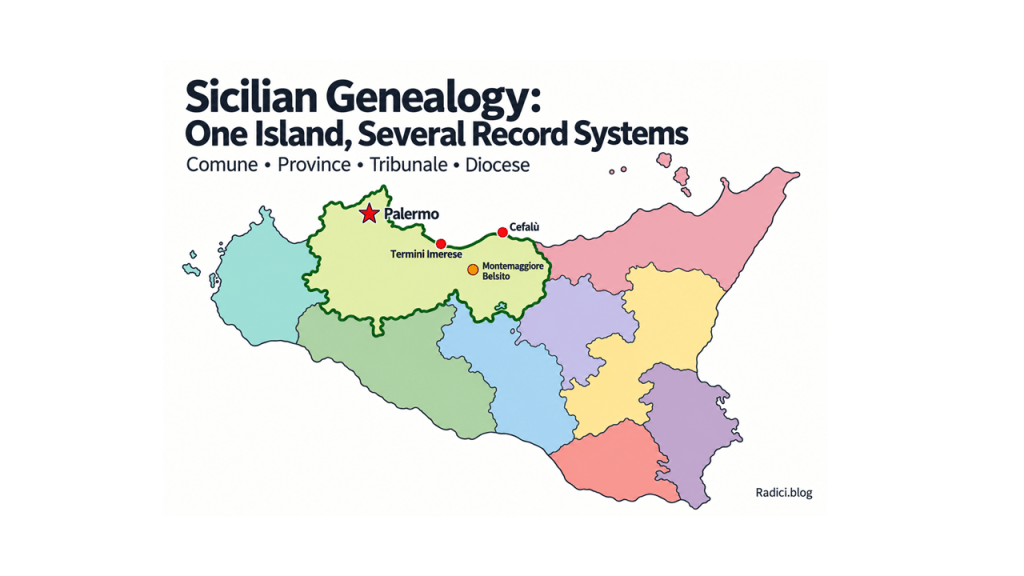
A Sicilian town can belong to one province for civil administration, a different geographic jurisdiction for the Catholic Church, and yet another for judicial purposes. Those distinctions can determine where records were created, where copies were sent, where they eventually ended up—and where you need to look for them today.
Sicily is an excellent demonstration of one of the basic principles of the Radici method:
Records are created by systems. To find the records, learn the systems.
Start With the Comune
As elsewhere in Italy, the fundamental geographic unit for most civil genealogical research is the comune, not the province.
Knowing only that your ancestor came from “Palermo” or “Messina” is usually not enough. You need to identify the actual comune—and sometimes the smaller frazione or locality within it.
The province is nevertheless important because it helps identify the larger civil and archival structure surrounding the comune.
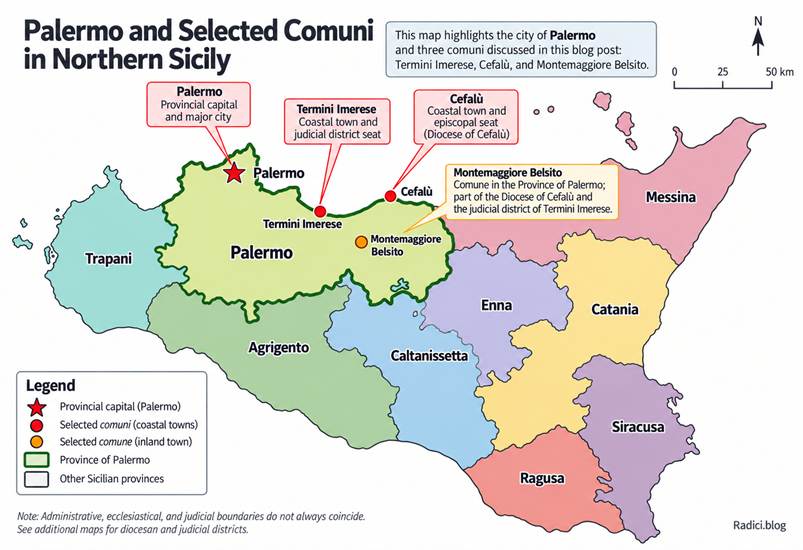
Once you have identified the comune, begin building a locality guide. At minimum, determine:
- the modern and historical province;
- the government that controlled the locality during the period you are researching;
- when civil registration began;
- the relevant Archivio di Stato;
- the historical tribunal;
- the parish or parishes;
- the diocese; and
- which records are available through FamilySearch, Antenati, or other repositories.
This preliminary work matters particularly in Sicily because these jurisdictions do not necessarily coincide. Your civil, ecclesiastical, and judicial searches may send you in three different directions. 1
Civil Registration: Sicily Gives You an Early Start
One of the first things a researcher needs to understand is that Sicilian civil registration did not begin with Italian unification.
For most Sicilian comuni, civil registration begins around 1820, while Sicily was under Bourbon rule as part of the Kingdom of the Two Sicilies. Assuming the records have survived, births, marriages, and deaths can therefore often be traced several decades before the creation of the Kingdom of Italy.
Sicily became part of the new Kingdom of Italy in 1861. Garibaldi’s forces had taken the island from Bourbon rule in 1860, and Sicily was included when the Kingdom of Italy was proclaimed on March 17, 1861.
That date is worth emphasizing because “Italian unification” was a process, not an event that occurred everywhere at once. Sicily was part of the Kingdom of Italy from its beginning in 1861; Veneto was incorporated later, and Rome and the remaining Papal territory later still.
Nor should we expect the political transition of 1861 to produce an instantaneous break in every local record series. Governments can change more quickly than administrative practices.
For Sicilian genealogy, then, 1820 and 1861 represent two different kinds of landmarks:
1820 marks the approximate beginning of the Bourbon civil registration system that genealogists rely upon.
1861 marks Sicily’s incorporation into the Kingdom of Italy and the beginning of the transition toward the administrative systems of the unified Italian state.
That distinction is important. If you begin looking for Sicilian civil records only in the post-unification period, you may be ignoring roughly forty years of excellent civil documentation. 2
What You May Find in the Civil Registers
Civil records can be especially rich. In addition to the basic acts of birth, marriage, and death, researchers may encounter marriage attachments or supplements and miscellaneous civil acts containing information unavailable in the main registers.
This is one reason it is important not to limit yourself to typing a name into a search box. An increasing number of Italian records are indexed, but many are not. The images themselves may contain considerably more than the searchable index reveals. Browse the registers when necessary rather than assuming an unsuccessful name search means that no record exists.
Why the Tribunale Matters
Civil records were not simply created in a comune and left there.
Copies of records moved through the judicial system. That makes the tribunale an important part of the chain of custody—and sometimes an important clue to finding records online. 3
Montemaggiore Belsito provides an excellent example.
For civil purposes, Montemaggiore Belsito is in the Province of Palermo. Ecclesiastically, however, it belongs to the Diocese of Cefalù. Historically, its judicial jurisdiction was the Tribunale di Termini Imerese.
One town. Three systems.

FamilySearch has civil records associated with the Tribunale di Termini Imerese. A researcher looking only under the name of a particular comune—or assuming that everything associated with Palermo Province will simply be catalogued under Palermo—can miss relevant material.
If you cannot find a Sicilian comune where you expect it on FamilySearch, find out which tribunal had jurisdiction over it and search again.
The record may not be missing at all. You may simply be looking under the wrong jurisdiction.
Before Civil Registration: Follow the Church
Eventually the civil records run out. For Sicily, that usually means you have reached the early nineteenth century. Then the Catholic Church becomes central to the research.
Depending on survival and local practice, parish collections may include baptisms, marriages, deaths or burials, confirmations, stati delle anime, and other sacramental or administrative records.
Here again, geography matters.
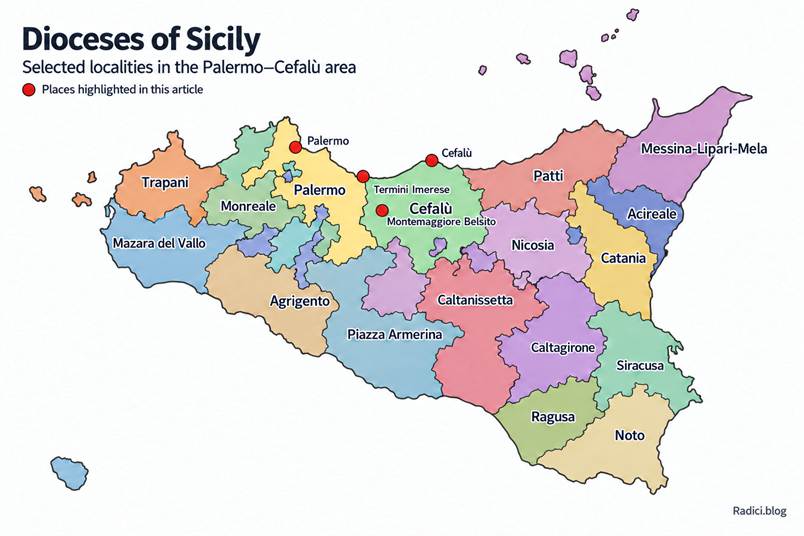
The province tells you very little about where Catholic records should be found. You need to identify the parish and the diocese. 4
Montemaggiore Belsito again illustrates the problem beautifully. A researcher who sees “Province of Palermo” might naturally assume that older church records would fall under the Archdiocese of Palermo. They do not. The relevant diocese is Cefalù.
And identifying the diocese still does not tell you where the books physically are.
Older parish registers may remain in the parish. Some have been transferred to diocesan archives. Some have been filmed. Some have not. Before writing to anyone, determine as much as possible about custody.
Don’t Stop at Birth, Marriage, and Death
One of my favorite examples of the value of looking beyond the obvious records comes from research conducted by one of my students in Cefalù.
Her great-grandfather was a foundling. The records referred to him under a bewildering succession of names, including Samuele Radice Esposito, Esposito Emmanuele Radice, Esposito Michele inteso Radice, Esposito Radice Samuele, and eventually Michele Sanfilippo.
His birth record told one story. But it wasn’t the whole story.
An entry among the Atti Diversi revealed something the ordinary birth record did not: three days after the infant had been placed in the foundling wheel, his natural mother returned and reclaimed him. 5
Browse the whole collection.
The genealogically important document may not be filed where you expect it—or even be the type of document you thought you were looking for.
Going Back Further: The Riveli di beni e anime
Sicily offers another remarkable source for research before modern civil registration: the Riveli di beni e anime.
The Riveli were fiscal censuses conducted at irregular intervals from the sixteenth century into the early nineteenth century. They were created for taxation rather than genealogy, but the information they contain can be extraordinarily valuable to family historians.
Depending on the record, a rivelo may identify:
- the head of household;
- spouse and children;
- ages;
- servants or other household members;
- real property;
- livestock and other possessions;
- occupation or social status; and
- taxes or exemptions.
The surviving series include numerous years between 1548 and 1816.
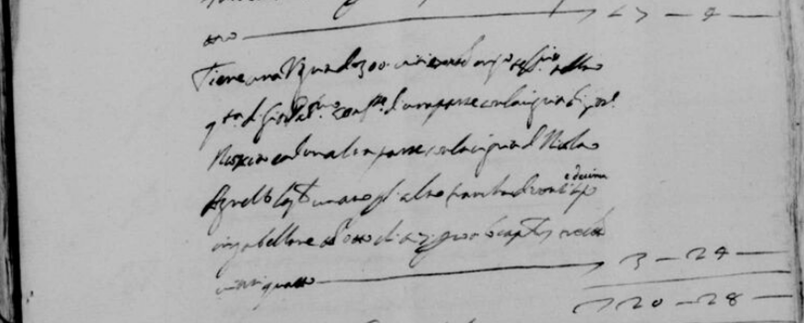
A page from the 1652 Riveli di beni e anime for Montemaggiore Belsito. These household declarations recorded family members, property, and taxable assets.6
For genealogists accustomed to relying on sacramental registers before civil registration, the Riveli offer something different: a snapshot of a household and its economic circumstances.
They can help answer not simply who was related to whom, but how a family lived.
Riveli Are Not the Catasto Onciario
This distinction is worth making because the two sources are sometimes confused.
The Catasto Onciario, created principally between 1741 and 1753, was a tax census of the Kingdom of Naples. Although Sicily and Naples were ruled by the same Bourbon monarch, Sicily was separately administered and was not included in the Catasto Onciario.
Sicily had the Riveli di beni e anime instead.
So if your ancestors were Sicilian, searching for their town in the Catasto Onciario is likely to send you down the wrong path.
Again, history determines the records.
Beyond Civil, Parish, and Riveli Records
Once you understand the major systems, other sources become possible.
Your Sicily locality guide may point you toward notarial records, land and property records, military sources, census material, or other local archival collections. Notarial records in particular can be extraordinarily valuable, but once again jurisdiction matters: you need to determine which notarial district served the locality and where those records are now held.
This is why I recommend creating a locality guide before embarking on serious research.
The guide isn’t busywork. It is a map of the institutions that surrounded your ancestors.
Sicily Rewards the Prepared Researcher
Sicilian genealogy can seem complicated because there are so many overlapping systems. But those systems are also the reason the documentary record can be so rich.
A civil record may lead you to a tribunal collection. A parish may lead you to a diocese you did not expect. A rivelo may take you beyond names and dates and introduce you to a household’s property, occupation, and economic circumstances. An obscure miscellaneous civil record may completely change what you thought you knew about a child’s birth.
The trick is not simply to search harder.
It is to understand where you are, when you are, who created the records, and where those records went next.
That is particularly true in Sicily—but it is also one of the most important lessons Italian genealogy has to teach.
Endnotes
1. See “Before You Begin: Preparing for Genealogical Research in Italy” and “Italian Locality Mysteries #1” on Radici.blog for more on locality guides, historical jurisdictions, and the importance of identifying the correct place before searching.
2. For a fuller explanation of Italian genealogical record sources by historical period—including the Napoleonic era, Restoration, and the varying chronology of unification—see “The Radici Method” on Radici.blog.
3. See “Digitization, Custody, and Structural Traps in Italian Genealogy” on Radici.blog for a more detailed discussion of the Comune → Tribunale → Archivio di Stato chain of custody and why surviving records may not appear where a researcher expects them.
4. See “Finding the Parish” on Radici.blog for methods of identifying the parish that served an ancestor, and “Beyond the Digital Door” for the practical challenges of accessing parish records once the parish has been identified.
5. See “The Foundling Record Everyone Missed” on Radici.blog for the fuller discussion of this Cefalù foundling case and the importance of looking beyond the expected birth, marriage, and death registers.
6. Archivio di Stato di Palermo, Riveli di beni e anime, Montemaggiore Belsito, 1652, digital image 88 of 493, Portale Antenati, https://antenati.cultura.gov.it/ark:/12657/an_ua37946890/ydo93PD, accessed 7 September 2026.


Comments are moderated. Substantive contributions are welcome.Leave a Reply